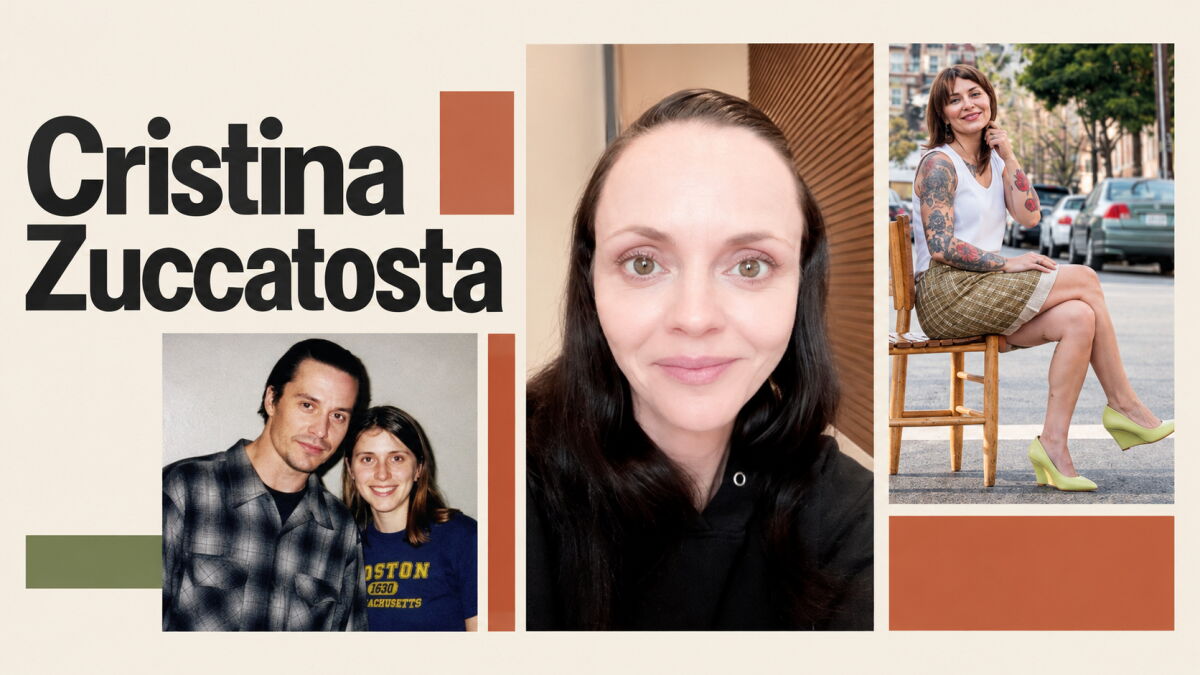
Basic Information
| Field | Details |
|---|---|
| Full Name | Cristina “Titi” Zuccatosta |
| Also Known As | Titi Zuccatosta; Cristina Patton |
| Nationality | Italian |
| Professions | Visual artist; Interior designer; Creative consultant |
| Notable Relationship | Married to musician Mike Patton (commonly reported since 1994) |
| Reported Separation | Around 2001 (periods of separation are mentioned in public summaries) |
| Children | None publicly reported |
| Languages | Italian, English |
| Known Locations | Bologna, Italy; San Francisco, USA |
| Public Persona | Low-profile; work-centered; privacy-valuing |
Names, Identity, and the Art of Staying Out of the Spotlight
Cristina Zuccatosta is most often introduced as an Italian visual artist and interior designer who keeps a deliberately quiet public profile. Across design portfolios and community mentions, she is alternately listed as “Titi” (a familiar nickname), “Cristina Zuccatosta,” and, in some contexts after marriage, “Cristina Patton.” These variants reflect life phases rather than brand pivots; she has tended to let projects, rather than publicity, do the talking.
Her story—such as it is available—reads like a chiaroscuro painting: clear outlines of profession and places, with personal details kept in intentional shadow. The result is a public figure known more by craft, geography, and association than by the usual entertainment-world overshare.
Career: Interiors, Visual Art, and a Transatlantic Aesthetic
Cristina’s professional footprint points to interior and visual design, with work that intersects hospitality, retail, and personal environments. Portfolio-style listings identify projects in and around San Francisco, alongside references that situate her within Italian and American creative circuits. The through-line is a maker’s mindset—interiors with a stylist’s eye, visual projects with a spatial designer’s pragmatism.
What’s striking is the absence of splashy profiles or glossy magazine tours. Instead, her public outputs show up in the places designers typically thrive: project credits, studio blurbs, and lean online portfolios. You get a sense of someone who designs for use and feeling, not for headlines. Clean lines, layered textures, and contextual sensitivity appear to be the house style—quietly contemporary, occasionally romantic, and always functional.
Because she’s kept interviews scarce, her methodology is mostly inferred. But the contours suggest a designer who speaks fluent Italy (materiality, craft, history) and fluent California (light, space, comfort). That crosscurrent—marble and terrazzo meeting west-coast warmth—can be felt like sea air through an open window.
Personal Life and Family
Public records and long-standing music bios connect Cristina with Mike Patton, the singer and composer known for Faith No More, Mr. Bungle, and a raft of experimental projects. The marriage is commonly dated to 1994, with a period of separation around 2001 referenced in multiple summaries. Accounts also describe a life split between San Francisco and Bologna, a geography that dovetails with Patton’s Italian-language work and Cristina’s own roots.
No children are publicly reported. Beyond that, details grow scarce by design. The couple’s privacy seems less a media strategy than a way of life: minimal interviews, few public appearances together, no tell-all. In a culture that measures presence by noise, Cristina’s approach reads as a studied hush.
Timeline at a Glance
| Year/Period | Event |
|---|---|
| Early–mid 1990s | Marriage to Mike Patton is widely reported, commonly cited as 1994 |
| Late 1990s | Creative work credited in design and visual contexts |
| Circa 2001 | Separation is publicly noted in biographical summaries |
| 2010s | Continued design activity; low-profile online presence |
| 2020s | Ongoing mentions as an Italian visual/interior designer; maintains a modest footprint |
Public Presence and Digital Footprints
Cristina keeps her public-facing materials lean: portfolio-style listings, occasional professional profiles, and modest social activity consistent with a privacy-first stance. You’ll find the expected name variants in creative directories and project-credit sites. Beyond this, her visibility is refracted through community chatter—fans labeling images, threads revisiting long-known facts, and the endless echo of two large public names connected by marriage.
It’s a pattern familiar to anyone adjacent to celebrity: the person becomes a silhouette made from other people’s sentences. What helps clarify the picture here is the consistency across the basic facts—Italian designer, married in the ’90s, separation noted in the early 2000s, no children publicly reported, a career that prefers making to marketing.
What’s Verified, What’s Corroborated, and What’s Better Left as Rumor
When examining a life that resists overexposure, it’s useful to sort the firm from the foggy.
- Strongly verified: Italian nationality; work in visual and interior design; long-term marriage to Mike Patton in the 1990s; no publicly reported children; historical ties to Bologna and San Francisco.
- Well-corroborated but sometimes variably phrased: Marriage commonly cited as 1994; separation around 2001; name variants (Titi, Cristina Patton) appearing across professional and community contexts.
- Speculative or fan-theory: Any claims about the private terms of the relationship, day-to-day status updates, or supposed interpersonal arrangements. These tend to originate in forums and should be treated as ambient noise rather than fact.
A practical rule of thumb: if it reads like a diary entry and not a project credit or a long-standing biographical note, it’s probably rumor.
Finances, Property, and the Silence of Good Taste
There is no authoritative public estimate for Cristina’s net worth. Designer incomes vary wildly by project scope, client mix, and geography, and she has not positioned herself as a media-facing “brand” that courts such disclosures. In a field where taste often substitutes for volume, her decision to keep money talk—and much else—offstage feels entirely coherent.
Influence and Cultural Footprints
It’s impossible to describe Cristina’s public life without acknowledging the creative proximity to Italy’s language, materials, and music. Those strands run through adjacent narratives: an Italian household; a partner immersed in Italian projects; time spent in Bologna; design work that—by location and training—leans into continental craft. Like luminous underpainting, it’s seen best in the works themselves rather than in statements about them.
If Cristina’s presence has influenced the cultural arc around her—and it likely has—the most respectful reading is that she did so by being who she is: a working designer, an Italian creative, a private person navigating public adjacency.
FAQ
Who is Cristina Zuccatosta?
She is an Italian visual artist and interior designer known for a low-profile public persona.
Is she married to Mike Patton?
Yes, she is widely reported to have married musician Mike Patton in the 1990s.
What year did they marry?
The marriage is commonly cited as 1994 in public summaries.
Are they still together?
Public accounts note a separation around 2001; beyond that, the couple keeps their private status largely private.
Do they have children?
No children are publicly reported.
Where has Cristina lived?
She has longstanding ties to Bologna, Italy, and San Francisco, USA.
What does she do professionally?
She works in interior and visual design, with credits spanning residential and commercial contexts.
Why is there so little public information?
Cristina maintains a privacy-first approach, favoring project work over media exposure.
What are her known name variants?
She appears as Cristina Zuccatosta, Titi Zuccatosta, and, in some contexts, Cristina Patton.
Is there a definitive biography?
No single authoritative long-form biography exists; public information is limited to professional profiles and basic relationship notes.
Does she have social media?
She maintains a modest social footprint consistent with her overall privacy.
What is her net worth?
There is no reliable public estimate; figures circulating online should be treated as speculative.